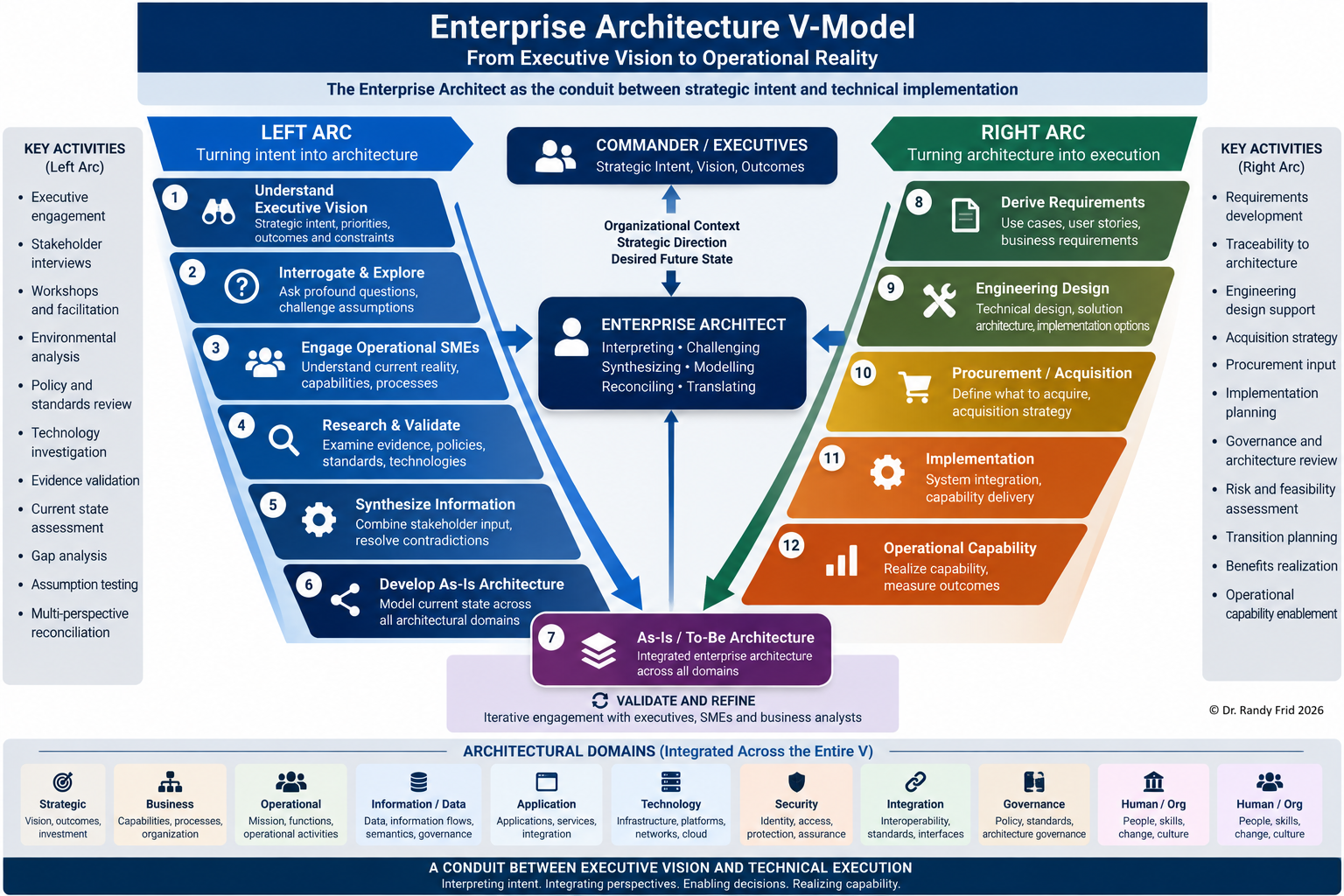
The Enterprise Architecture V
Left Arc – Vision to Architecture
Executive/Commander intent → strategic direction → future-state vision → Enterprise Architect → engagement with stakeholders & operational SMEs → investigation and validation → To-Be/As-Is architecture.
Right Arc – Architecture to Execution
Validated architecture → business analysis → use cases/user stories → business requirements → engineering → detailed technical design → procurement/acquisition → implementation.
Enterprise Architect Skill Positioning Model
Enterprise Architecture is positioned between executive intent and operational execution. The Enterprise Architect interprets strategic vision, challenges assumptions, synthesizes information from multiple sources, models current and future states, reconciles competing perspectives, and translates the resulting architecture into a form that can support requirements, engineering, acquisition and implementation.
The Four Dimensions of Enterprise Architect Capability
1. Horizontal Breadth – Architectural Domain Mastery
Governance; Business; Information/Data; Application; Technology; Security; Integration; Structural and Behavioural domains.
2. Vertical Depth – Abstraction and Decision Hierarchy
Executive intent → Enterprise strategy → Architecture → Business requirements → Engineering → Implementation → Acquisition.
3. Bidirectional Perspective – Top-Down and Bottom-Up
Top-Down: understand why the enterprise needs to change and what senior leadership is trying to achieve. Bottom-Up: understand operational reality, architectural constraints, technical consequences and implementation implications.
4. Human Integration – The Conduit Function
Executive vision is refined through engagement with stakeholders and operational SMEs, while business analysts capture the emerging requirements. The architect integrates these perspectives into coherent To-Be and As-Is architecture viewpoints and views.
The Enterprise Architecture Cognitive Cycle
INTERPRETING → CHALLENGING → SYNTHESIZING → MODELLING → RECONCILING → TRANSLATING
This cycle describes the intellectual work surrounding the visible architectural deliverable. The model is not merely an output: it is also a common language used to expose assumptions, test understanding, reconcile perspectives and establish a shared view of the enterprise.
Evidentiary Rule
The Enterprise Architect should rely on evidence rather than assertion. Where supported by the source material, work products should expose the effort between assignment and deliverable: stakeholder elicitation, executive engagement, operational discovery, research, evidence validation, interpretation, challenge, synthesis, modelling, reconciliation, requirements development, architecture, governance and translation.
Stakeholder engagement is treated as an architectural activity, not as an ancillary soft skill. The evidence should identify who was engaged, what information was extracted or reconciled, how the architecture was developed or validated, and what downstream activity the resulting architecture enabled.
Positioning Statement
Enterprise Architect (Level 3) – translates executive vision and strategic intent into enterprise architecture, integrating business, operational and technical perspectives to establish coherent To-Be and As-Is states and provide the foundation for requirements, engineering, acquisition and implementation.